.png)


Behind the Behaviour: What Art Therapy Can Offer Young People in Residential Care

Updated: Jul 16
(Art Therapy in Manchester | Therapy in Manchester)— Hey From Within

"He didn't touch a single art material today."
It would have been easy to think nothing happened.
The paints stayed untouched. The pencils remained neatly in their pot.
Instead, we played a game of Connect Four.
He won every round.
Between each move, there were long silences. We spoke about football, what was for tea, and whether dinosaurs would win against sharks.
There was no conversation about why he had come to therapy.
No disclosures.
No tears.
When the session ended, he looked at me and quietly asked,
"Are you here next week?"
For many young people living in residential care, this is where therapy begins.
Not with words.
Not with artwork.
But with the question,
"Will you still be here?"
Art Therapy in Residential Care: Looking Beneath the Surface
Working as an art therapist in Manchester, I often return to the image of an iceberg.
Above the waterline sits the behaviour we can all see.
The anger. The swearing. The refusal. The running away. The silence. The endless energy. The shutdown. The self-harm. The pull to risk taking behaviours.
These behaviours are visible.
What we cannot immediately see are the experiences beneath them.
Attachment disruptions.
Developmental trauma.
Loss.
Fear.
Shame.
The repeated experience of adults leaving.
The nervous system simply trying to survive.
When we understand behaviour through this lens, our question gently shifts.
Instead of asking,
"What's wrong with this young person?"
we begin asking,
"What has happened to them?"
and perhaps even,
"What might they need from us right now?"
This small shift can completely change how a young person experiences the adults around them.
Art Therapy Is Not About Making Good Art
One of the biggest misconceptions about art therapy is that it is about drawing.
It isn't.
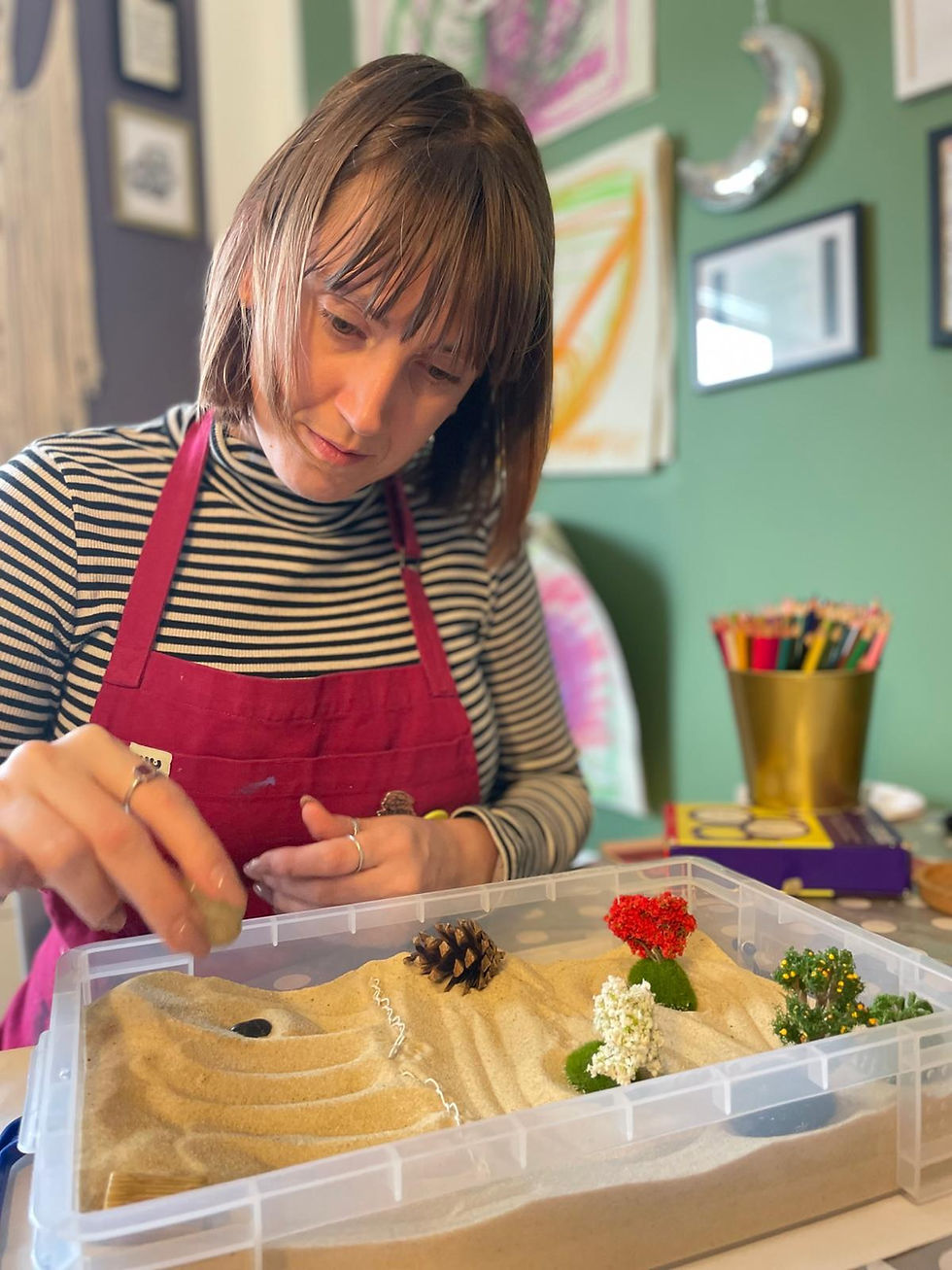
Art becomes another language.
Sometimes that language looks like clay.
Sometimes it looks like guided drawing.
Sometimes it looks like ripping paper.
Sometimes it looks like sitting on the floor playing Uno for forty-five minutes.
Young people communicate safety before they communicate stories.
For some, the safest way to explore emotions is symbolically.
For others, the relationship itself becomes the therapy.
They may spend weeks testing whether I'll still arrive.
Whether I'll remember something important they shared.
Whether I'll notice when something feels different.
This is therapeutic work.
Even if no artwork is made.
Why Consistency Matters
Many young people living in residential settings have experienced adults coming and going throughout their lives.
Because of this, consistency often becomes more powerful than interpretation.
Returning each week.
Holding boundaries kindly.
Remaining curious.
Allowing silence.
Not rushing disclosure.
These experiences slowly teach the nervous system something different.
Perhaps adults can stay.
Perhaps relationships can become predictable.
Perhaps this space is safe enough to begin wondering about what lies underneath the surface.
Art Therapy in Manchester for Young People in Residential Care
My work offers individual art therapy sessions for young people in residential care across Manchester and the surrounding areas.
Sessions are tailored to each young person's developmental needs, attachment history, communication style and interests.
Some young people arrive ready to make art.
Others need weeks or months of relationship building before creativity feels possible.
Neither approach is better.
Both deserve time.
As the therapeutic relationship develops, creativity often becomes a bridge between experiences that feel difficult to explain and emotions that have never had the opportunity to be safely understood.
Rather than asking young people to simply talk about what has happened, art therapy allows us to wonder together.
Sometimes the artwork tells us things words cannot.
Supporting the Wider System Around the Young Person
Although art therapy takes place one-to-one, change rarely happens in isolation.
Young people do not return to therapy each week as a blank slate.
They return having been held by the adults around them. The residential support workers who greet them in the morning, notice when something feels different, sit alongside difficult evenings, celebrate small successes and quietly show up again the next day.
These relationships matter.
In many ways, they become the therapy between therapy.
Working in residential care is deeply meaningful work. It is also emotionally demanding. Support workers often witness extraordinary resilience alongside significant distress. They hold hope when young people cannot find it themselves, remain alongside behaviours that can feel challenging, and continue offering care even when progress feels difficult to see.
This emotional labour deserves space to be thought about too.
Alongside individual art therapy for young people in Manchester, I also offer reflective consultations for residential teams. These spaces are not about judging practice or finding fault. They are an opportunity to pause, think together and remain curious about what might be happening beneath a young person's presentation.
Together we might wonder:
"What could this behaviour be communicating?"
"What might this young person need right now?"
"How has their past shaped what we are seeing today?"
Often, simply slowing down to think psychologically allows empathy to re-emerge. Behaviour that once felt frustrating begins to make sense when viewed through the lens of attachment, trauma and nervous system survival.
I also recognise that no two homes are the same. Reflective consultations can therefore be tailored to the needs of an individual young person, a residential team, or an entire home. Some teams may benefit from thinking together about one young person's presentation, while others may want regular reflective practice to support staff wellbeing, strengthen therapeutic thinking, or reduce the impact of compassion fatigue and burnout.
One of the things I value most is recognising that residential support workers often know their young people incredibly well. You notice the subtle changes that others may miss. You know what helps them settle after a difficult day, when humour is needed, when silence feels safer than questions, and when something simply doesn't feel quite right.
This attunement matters.
For many young people with experiences of developmental trauma, healing is not found in one relationship alone. It is experienced across many consistent, safe relationships. Every moment a young person feels noticed, understood and accepted helps their nervous system learn something new about adults and about themselves.
Therapy is one part of that picture.
When the adults surrounding a young person feel supported, valued and able to remain curious, the therapeutic work extends far beyond the therapy room. Together, we create an environment where young people can begin to feel safe enough to trust, explore and gradually make sense of what has been happening beneath the surface.
Healing Happens in Relationships
Art therapy is one relationship.
Residential care offers many more.
When young people experience adults who remain curious instead of critical...
Adults who wonder before reacting...
Adults who continue showing up...
Something begins to change.
Not always quickly.
Not always visibly.
But steadily.
Just as creativity unfolds through safety, healing often unfolds through relationships that stay.
An Invitation
Whether you are a residential home, local authority, social worker or residential support worker looking for art therapy in Manchester, support for a young person, or reflective consultation for your team, I believe meaningful change begins with curiosity.
Not everything needs fixing.
Sometimes it needs understanding.
And when we begin to understand what is happening beneath the surface, young people no longer have to carry it alone.
Related Blogs
What the Children Bring, What the Parents Hold and What Schools See
When Grown Ups Need Crayons Too
Chloe Sykes
Art Psychotherapist | Yoga Teacher www.heyfromwithin.co.uk
(Art Therapy in Manchester | Therapy in Manchester)— Hey From Within


Comments